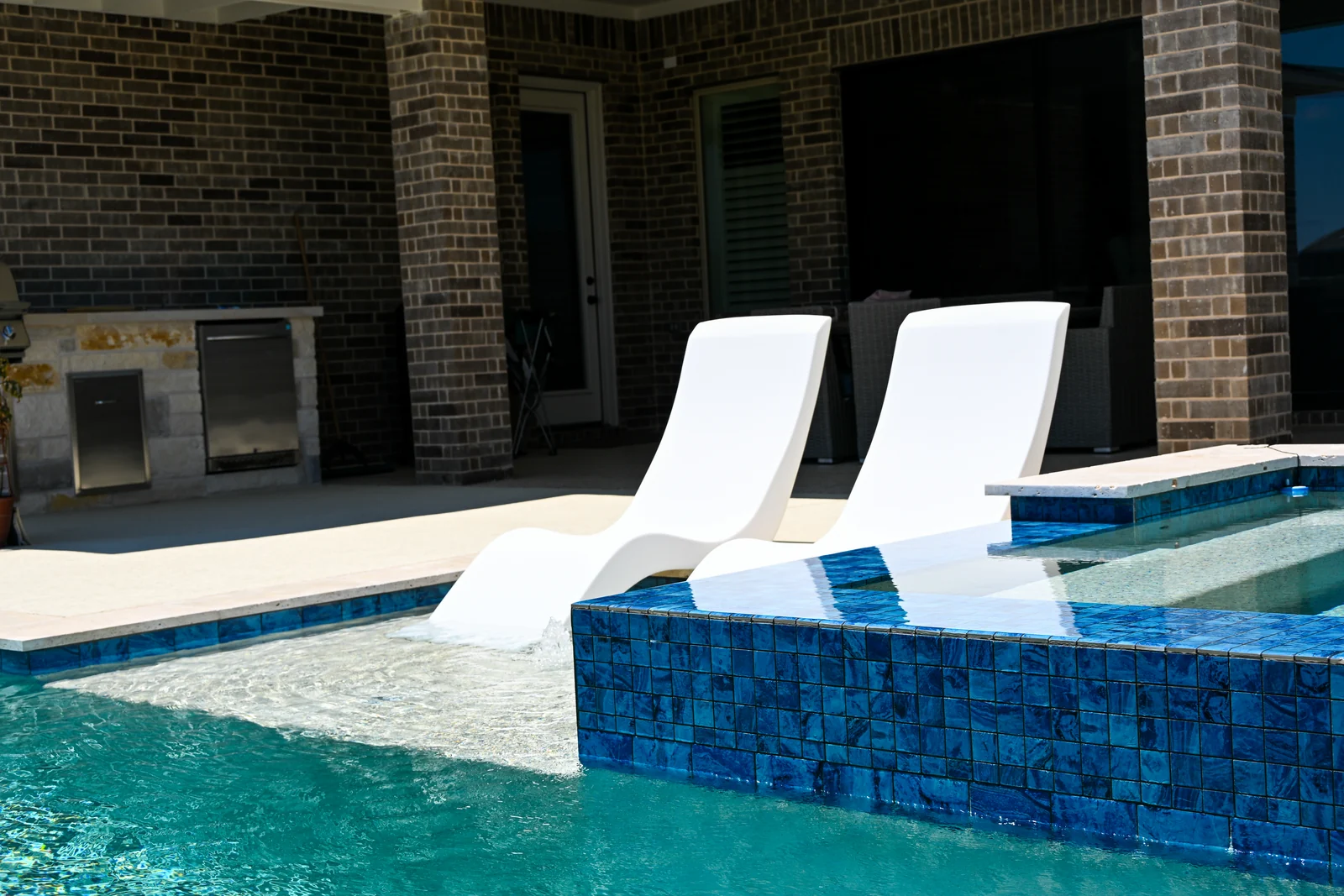
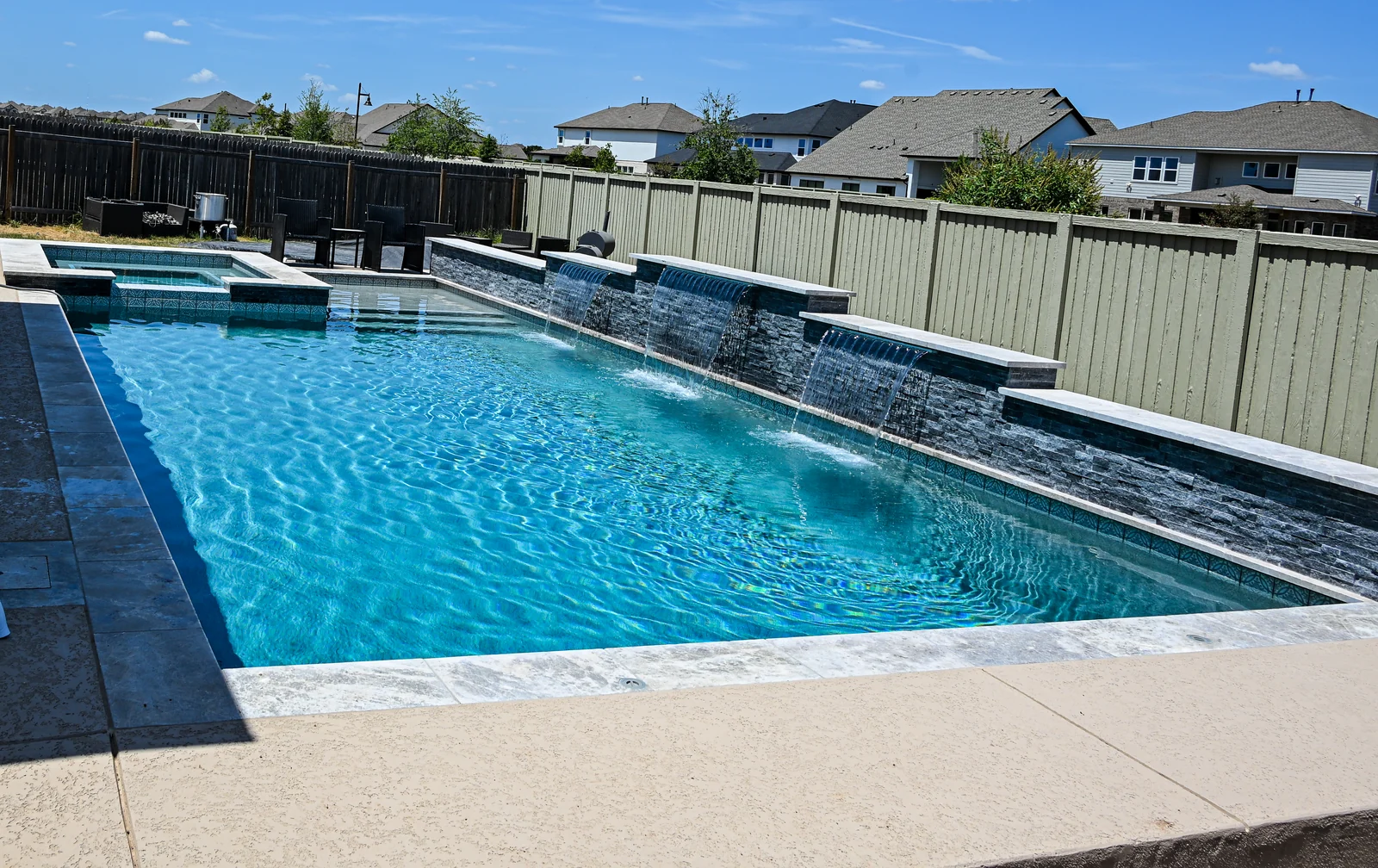
A crack at the pool coping usually means something moved, and the coping is where it showed. Three things move around a Central Texas pool: the deck, the ground under it, and the stone as it heats and cools. Which one is behind your crack decides whether the fix is a resealed joint, a few reset stones, or a drained pool and a bond beam repair.
Coping sits on the bond beam, the reinforced rim at the top of the gunite shell. The deck sits on the dirt behind it. A crack in the mortar between stones, a split through a stone, a gap between coping and deck, and coping that has lifted are four different symptoms, in roughly that order of concern.
Why the ground under a Central Texas pool moves
East of the Balcones Escarpment, much of the Austin and Georgetown area sits on the Blackland Prairie clay the USDA Natural Resources Conservation Service maps as the Houston Black series. Its official description puts the clay content at 40 to 60 percent and calls the shrink-swell potential high: cracks 1/2 to 4 inches wide at 12 inch depth in dry periods, open for 90 to 150 cumulative days in most years.
The University of Texas Bureau of Economic Geology draws the line through the city: west of MoPac, Austin is hilly on Glen Rose and Edwards limestone with thin, rocky soils, and east of MoPac it is flat on deep, well developed soils. A pool in Cedar Park is often on rock; a pool in Pflugerville or Hutto is often on clay that moves every year. We ask where a pool is before we guess at a crack.
Clay that opens a 4 inch crack when it dries closes it when it rains. The deck rides that cycle, and the coping is where the ride shows.
The joint behind the coping, and why it fails first
The deck is meant to be separated from the coping by a flexible joint. Penn State's concrete engineering library describes an isolation joint as one that permits horizontal and vertical movement between a slab and a fixed part of a structure, which is exactly this joint: the deck is the slab, the shell is the structure. Mortared solid or packed with sand, it lets the deck push on the bond beam every time it expands.
The push is small and relentless. The Federal Highway Administration lists the thermal expansion of limestone-aggregate concrete at 4.34 millionths per degree Fahrenheit, from 813 samples. A 20 foot run of deck, 240 inches, moving through an 80 degree swing changes length by about 0.08 inch. That is nothing while the joint is open and everything once it is packed, because the coping is the first thing in its way.
The sealant is engineered for that movement. W. R. Meadows rates its Deck-O-Seal pool deck sealant to ASTM C920 Class 25, meaning the cured joint can stretch or compress up to 25%, and its data sheet is specific about the joint: at least 1/4 inch wide and no more than 1 inch, sealant 1/4 to 1/2 inch deep at a 2:1 width-to-depth ratio, over a backer rod, cleaned of incompressibles. A joint built to other proportions cannot do its job, whatever is poured into it.
Which cracks matter, and which are cosmetic
- A hairline crack in the mortar between two stones that are both solid when pressed. Mortar shrinks as it cures; the Penn State library notes that contraction joints exist to control that drying shrinkage. Regrout it and watch it.
- A gap opening between coping and deck, with old sealant pulled away or crumbling. This is the joint failing before the coping does, which is the order you want. Cut it out, back it and reseal it.
- A crack running through a stone rather than around it. One stone is a reset. Several stones cracked in a line are following something underneath, usually the bond beam.
- Coping that has lifted, tilted or rocks under a foot. The bed has failed or the deck has heaved. The stone is telling you the cause is not the stone.
- Waterline tile letting go in a row directly under a cracked coping run. The bond beam has cracked and both finishes are coming off together. The tap test in our waterline tile post will find the hollow band.
What the repair is for each
A resealed joint is the smallest job and the one most often skipped. The old sealant comes out, the joint is cleaned to bare concrete, a backer rod sets the depth, and new sealant is poured. A new deck cures first; the Deck-O-Seal sheet cites 28 days as the standard.
A reset is one stone lifted, the bed chipped clean, and the stone re-laid in fresh mortar. A replacement is a run of stones, and it usually starts with a matching problem: travertine and flagstone vary by lot, so one new stone in an old run can be more visible than the crack was.
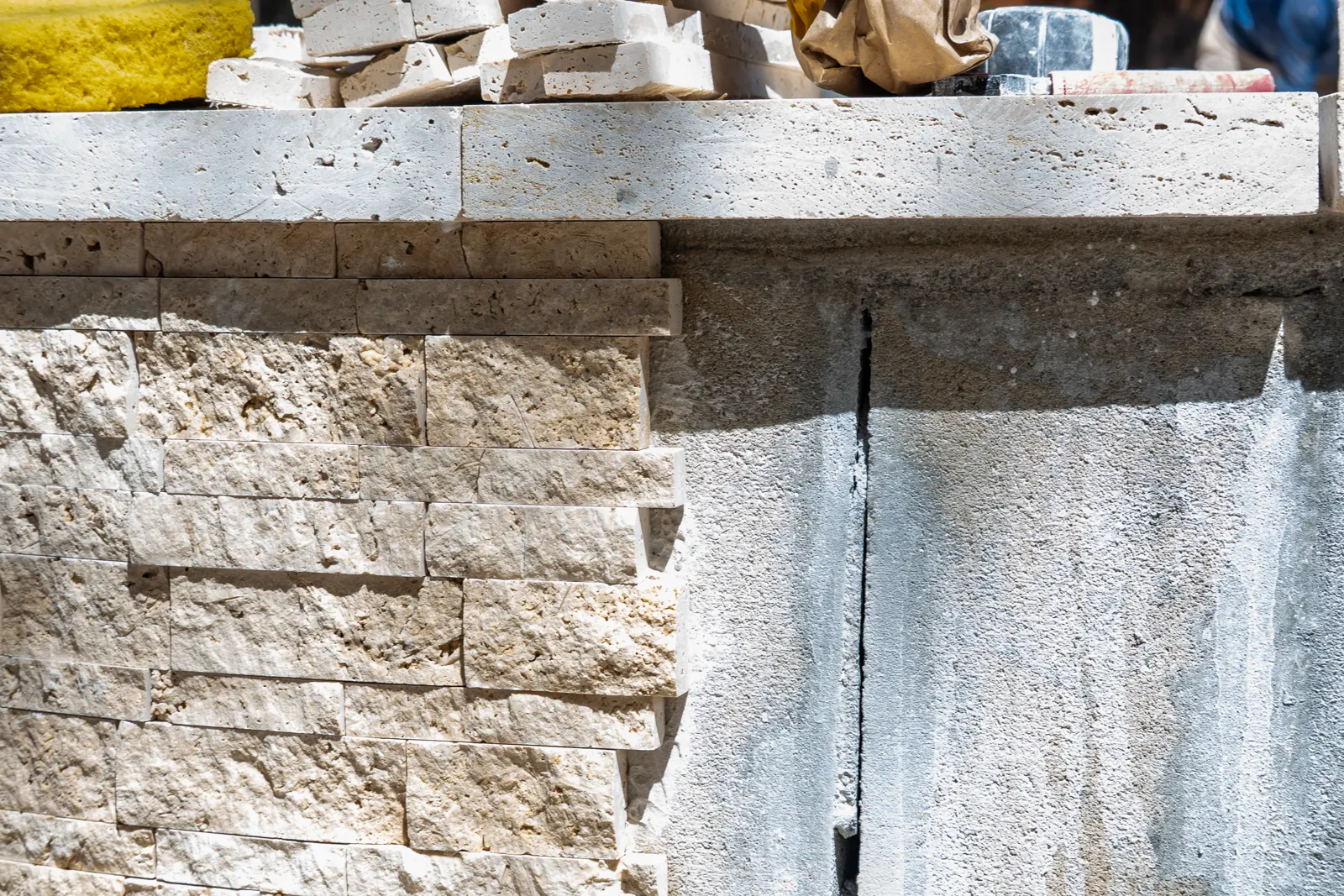
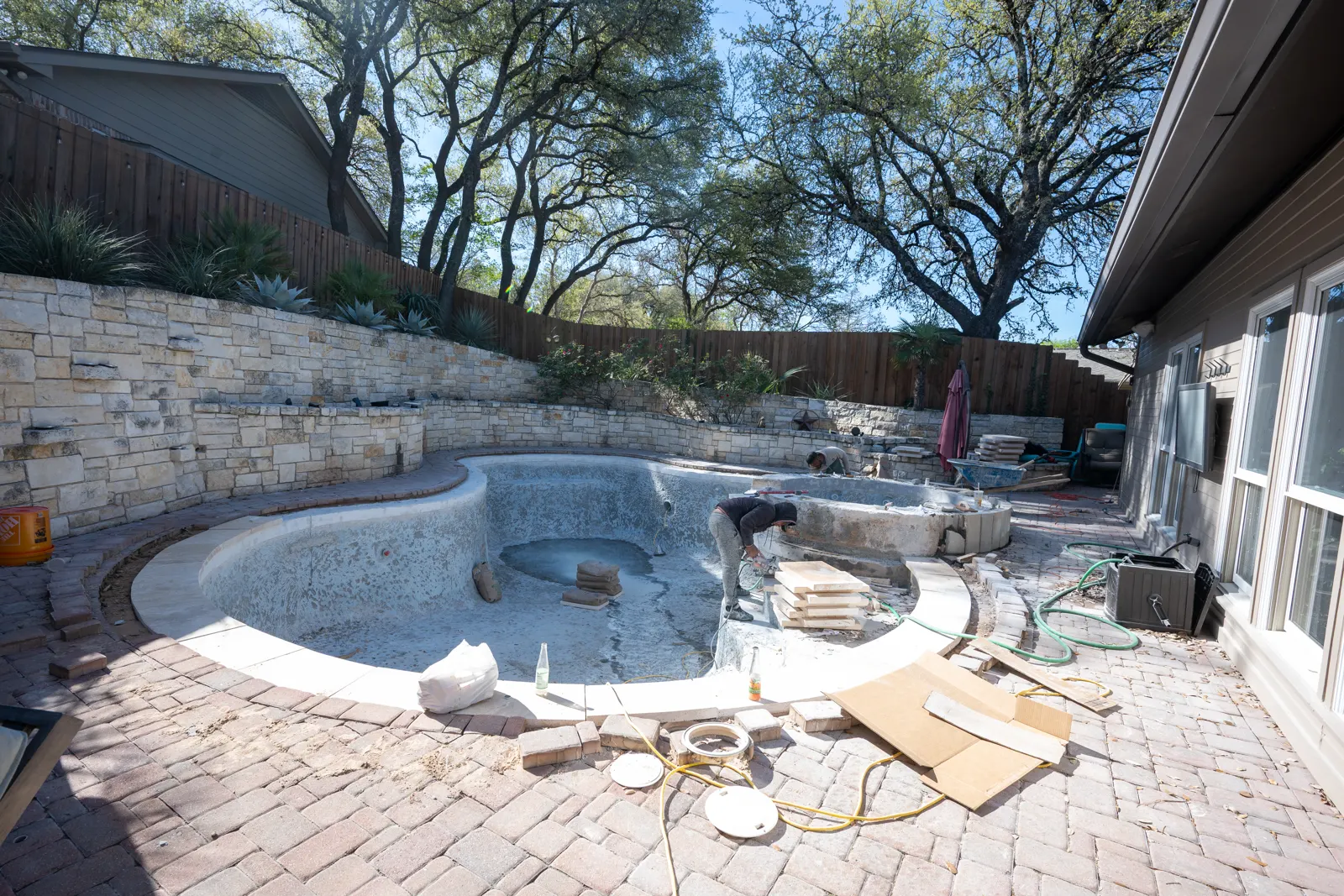
A bond beam repair is the drained-pool version, and a scheduled renovation rather than an afternoon. Coping and waterline tile in the affected run come off, the cracked beam is chipped back to sound material and rebuilt, and tile and coping go back on after it. The Adirondack Trail crack in the photo above only showed once the old finish was off, which is the point: on every pool repair we take on, the cause gets looked at before the finish goes over it.
When to do the work
Autumn, for the same reasons as tile. Deck-O-Seal is applied between 40 and 122 degrees, sets firm within 24 hours at 77 degrees, and needs 24 hours before rain. The National Weather Service puts Austin's normal highs above 90 from May 26 to September 23 and the average first freeze on November 29. October and early November sit between a deck too hot to work on and the first of the 12 sub-freezing days a year at Camp Mabry. Water sitting in an open joint through those freezes is what turns a small gap into a wide one by spring.
If you are looking at a crack now, send us a photo and where the pool is. Usually that is enough to tell a joint from a stone from a beam, and we quote only the part that needs touching.