Pool waterfalls and water features add sound and movement to a Central Texas pool, and the right one depends on how far the water falls, how much of it ends up in the air, and how long the feature runs. A feature that pours close to the surface loses less water than one that sprays, and a feature on a timer costs less to run than one left on all day.
What kinds of pool water features are there?
The common pool water features are sheer descents, rock waterfalls, grottos, bubblers and deck jets. They differ mainly in how far the water drops and how much it breaks apart on the way down.
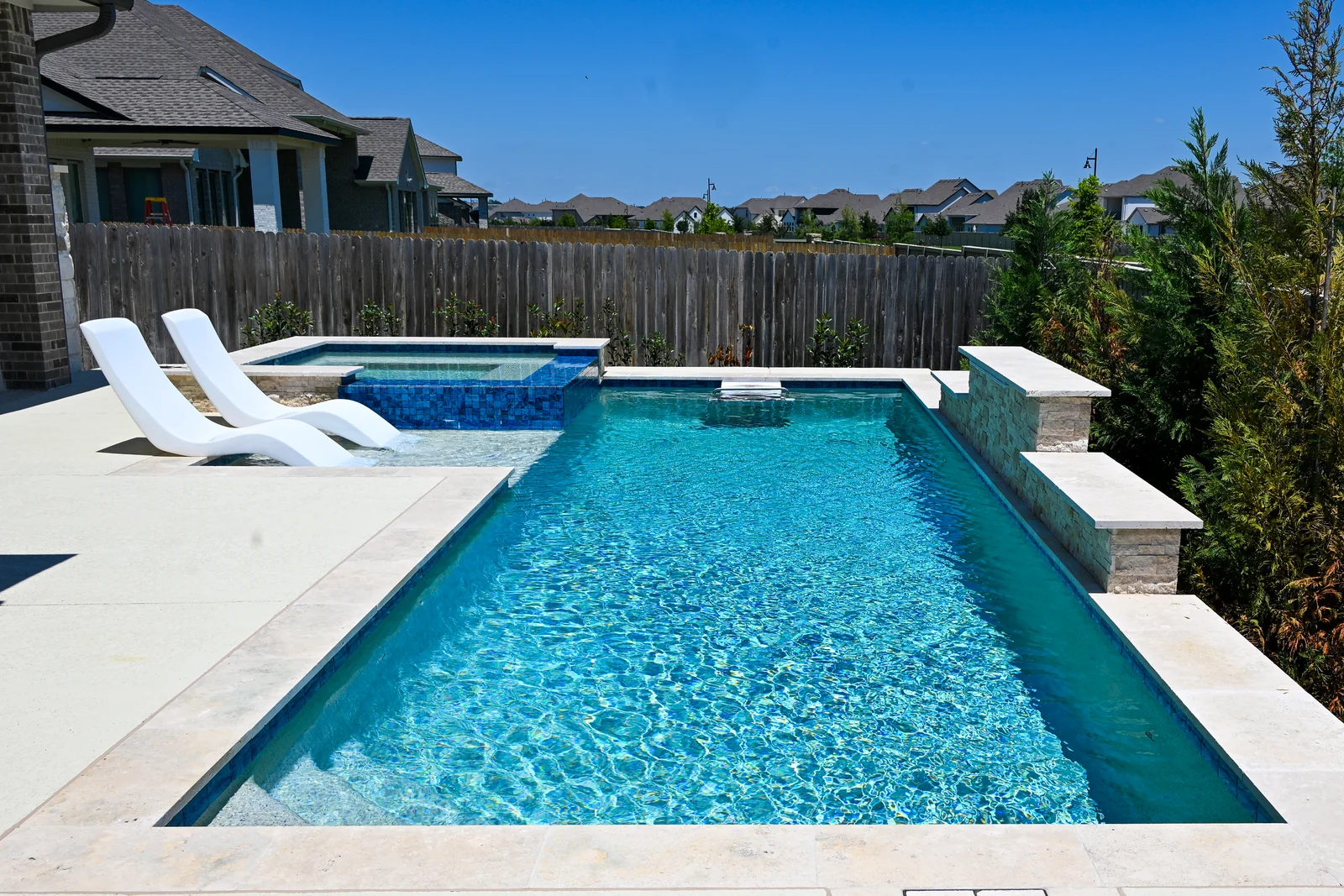
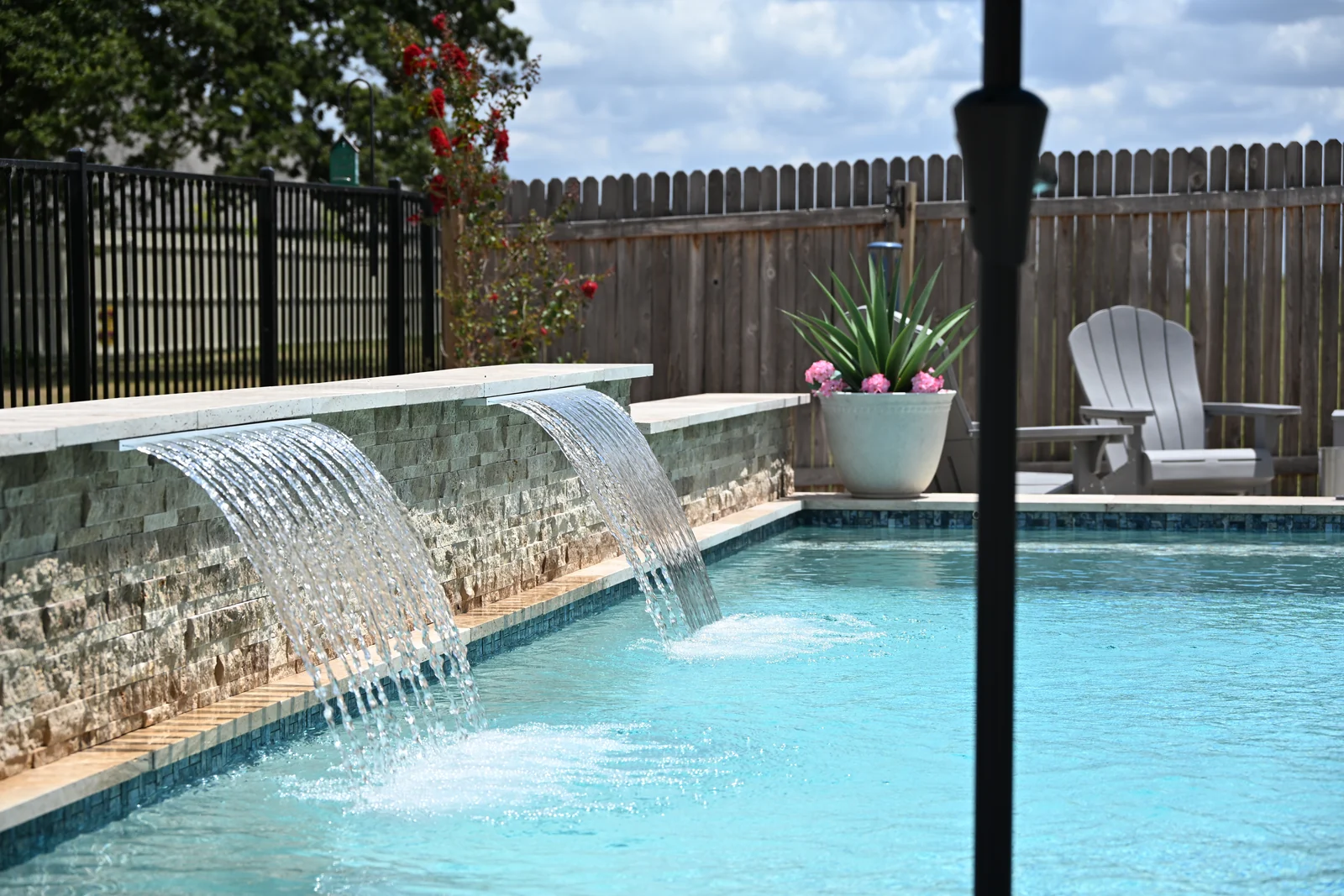
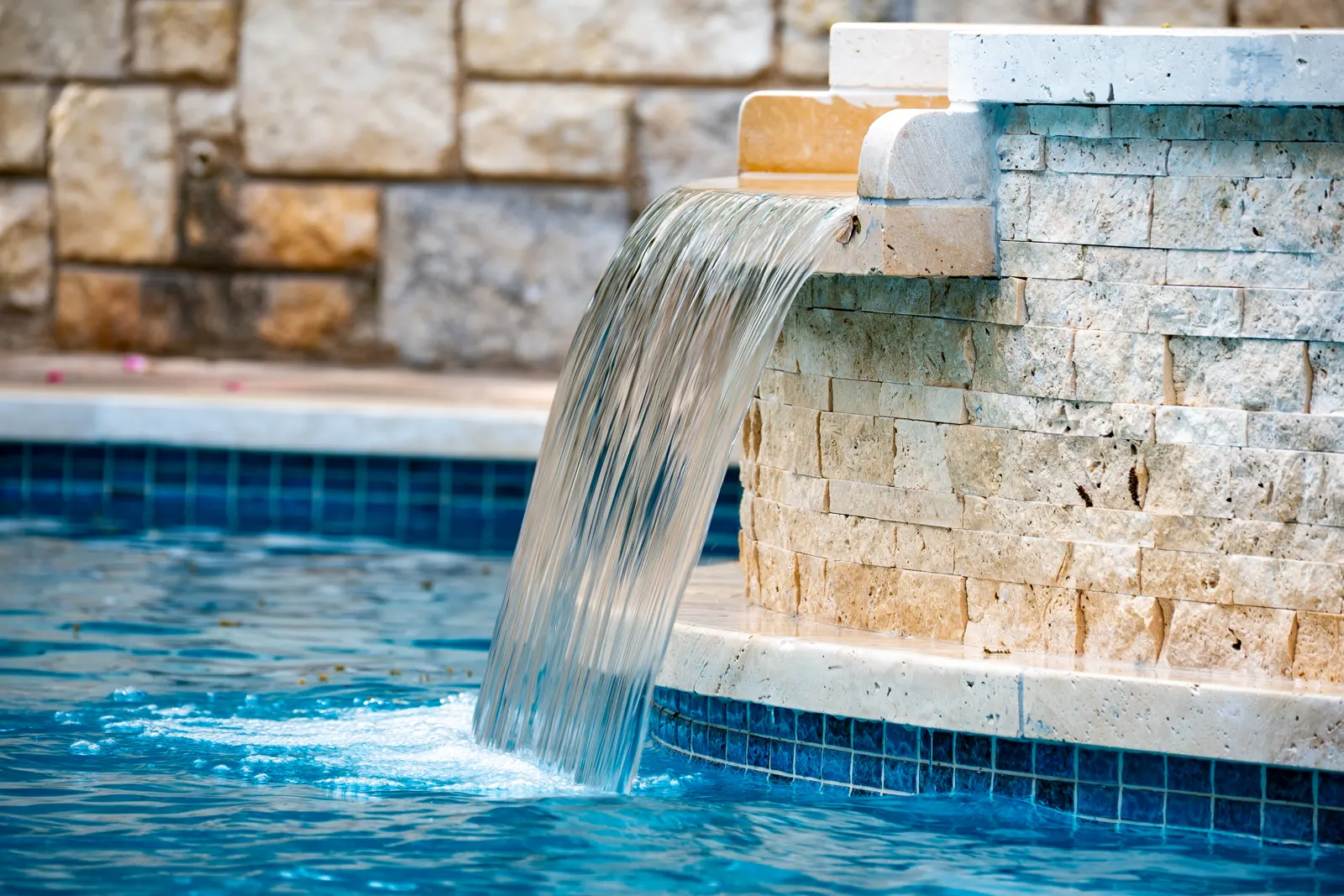
- Sheer descent: a smooth sheet of water poured from a slot in a raised wall. Clean lines, a steady sound and a short drop.
- Rock waterfall: water spilling over stacked natural stone. Trinity builds the rock structure on site rather than from a mold, so no two are the same.
- Grotto: a rock waterfall with a covered space behind the falling water, the largest and most structural feature of the group.
- Bubbler: a low jet that pushes water up through a shallow area such as a tanning ledge.
- Deck jet: an arc of water thrown from the deck into the pool, the feature that sends water furthest through the air.
Do waterfalls make a pool lose more water?
Waterfalls do make a pool lose more water, because they add turbulence to the surface. The EPA WaterSense guide Jump Into Pool Water Efficiency says the turbulence a fountain or waterfall adds increases evaporation and can also lose water to wind and splashing.
Evaporation is already a large number on its own. The same EPA guide calls evaporation one of the leading causes of water loss in residential pools in hot, dry climates, and estimates that an uncovered 500-square-foot pool can lose between 12,000 and 31,000 gallons a year to evaporation, depending on climate.
The shape of the fall matters. Austin Water's water saving tips note that trickling or cascading fountains lose less water to evaporation than fountains that spray water into the air. A sheer descent or a low rock spill sits at the efficient end of the range, and a tall deck jet arcing across the pool sits at the other.
The closer the water stays to the wall and the surface, the less of it the Texas air takes.
What do Austin's drought rules say about water features?
Austin's drought rules regulate ornamental fountains, and the limits tighten as lake storage drops. Under the year-round Conservation Stage, fountains must recirculate their water, which a pool water feature does by design. Austin Water reports that the city has been in Conservation Stage since September 2, 2025.
The City of Austin Drought Contingency Plan, dated November 21, 2024, ties each stage to combined lake storage. Conservation Stage holds while the reservoirs carry more than 1.4 million acre-feet, and Stage 2 begins when storage falls below 900,000 acre-feet. Under the plan:
- In Stages 2 and 3, ornamental fountains with a four-inch emission or fall of water are prohibited unless they preserve aquatic life.
- In Stage 4, the same four-inch rule applies without that exception, the city suspends approval of single-family residential pool permits, and filling spas is prohibited.
- In Emergency Stage 5, fountains cannot run unless they preserve aquatic life, and no water can be added to a swimming pool, pond, fountain or spa.
The plan speaks of ornamental fountains and does not name pool waterfalls, so whether a particular pool feature falls under the four-inch rule is a question for Austin Water. The practical point holds either way: a feature you can switch off from a phone is easy to stop when a drought stage calls for it. Towns around Austin write their own drought plans, so check with your own water utility.
How does a water feature affect pump energy?
A water feature adds pump energy because the water that feeds it has to be pushed, either by the pool's circulation pump running faster or by a dedicated pump. ENERGY STAR explains on its pool pump page that energy rises steeply with speed: reducing a pump's speed by half lets it use just one-eighth as much energy. A pump driving a waterfall works much harder than one turning over the water at a slow filtration speed.
That is why control matters as much as the feature itself. The EPA guide recommends running water features only while the pool is in use, or putting them on a timer that shuts them off after a set time or at night. The Pentair IntelliCenter and Jandy iAqualink systems Trinity installs put the waterfall in the same app as the lights and the spa. Our post on variable-speed pool pumps covers the pump side in more depth.
How do you tell a leak from a waterfall?
A pool with a water feature will lose some water to evaporation and splash, so the way to separate normal loss from a leak is to measure with the feature off. Austin Water suggests marking the water level at the skimmer and checking it 24 hours later; a drop of more than a quarter inch may mean a leak.
The EPA guide adds a bucket test. Shut down all pool systems, set a bucket of water on a step so most of it is submerged, mark both water levels, and compare them after 24 hours. If the pool dropped more than the bucket, the pool may have a leak. The EPA puts the rough line at more than 2 inches a week, or 3 inches in hot, dry areas with high evaporation.
Should you add a water feature at the build or later?
Adding a water feature during a new build is usually the cheaper route, because the plumbing, the raised wall and the electrical go in while the yard is already open. A waterfall can still be added to an existing pool as a standalone project, as our custom add-ons page explains.
Either way, plan the feature around the yard: where the sound carries, which way the wind pushes spray, and whether the feature runs on its own pump. Walls, fencing and plantings help too; the EPA notes that windbreaks and shade reduce evaporation. A custom pool build with Trinity Pool Construction starts with that conversation, and if you already have a pool and want the sound of water, we can look at your wall, your equipment and your yard and tell you what fits.